“We saw exactly why the buildings failed…and to be truthful, we’ve known why buildings fail for a long, long time,” laments Wooldridge, who earned his B.S. in biosystems engineering and M.S. in manufacturing systems engineering (with an additive manufacturing focus) from UK’s Stanley and Karen Pigman College of Engineering. “It isn’t a big mystery as to why they failed. We’ve had the engineering data and computer models for years. The problem is that every time we rebuild, we use the exact same materials and the exact same building processes.”
The devastation mirrored scenes Wooldridge had witnessed before: the EF3 and EF4 tornadoes that tore through Western Kentucky in December 2021, and the floods on both sides of the state in 2022 and 2023, when gentle streams became raging rivers in a matter of hours, sweeping buildings from their foundations, erasing roads and corralling vehicles into twisted piles beneath collapsed bridges.
For Wooldridge, the devastation wasn’t abstract: friends and neighbors were left homeless, repeating, once again, the familiar cycle of destruction and loss witnessed by folks in towns like Mayfield, Bremen, Hazard, Jackson and Hindman.
The merciless storms seem only to be intensifying. With each season, the question grows louder: how do we build something that lasts?
Wooldridge has asked that very question for years. From his base at Somerset Community College (SCC), where he serves as director of the Kentucky Community and Technical College System’s (KCTCS) Additive Manufacturing Center, he leads a team that is rethinking housing from the ground up — literally.
Kentucky’s unique position makes it a bullseye for severe weather — storms that, according to UK Agricultural Weather Center Senior Meteorologist Matthew Dixon, will only intensify and strike more often.
“Kentucky is in a unique spot,” Dixon explains. “Here in the lower Ohio Valley, different air masses collide. We have cold, dry air dropping in from Canada. We have warm, moist air rising from the Gulf. That mix makes Kentucky the perfect place for storms to ignite, sometimes leading to major disasters. Their frequency has surged in recent decades, taken to another level as our weather patterns become more extreme.”
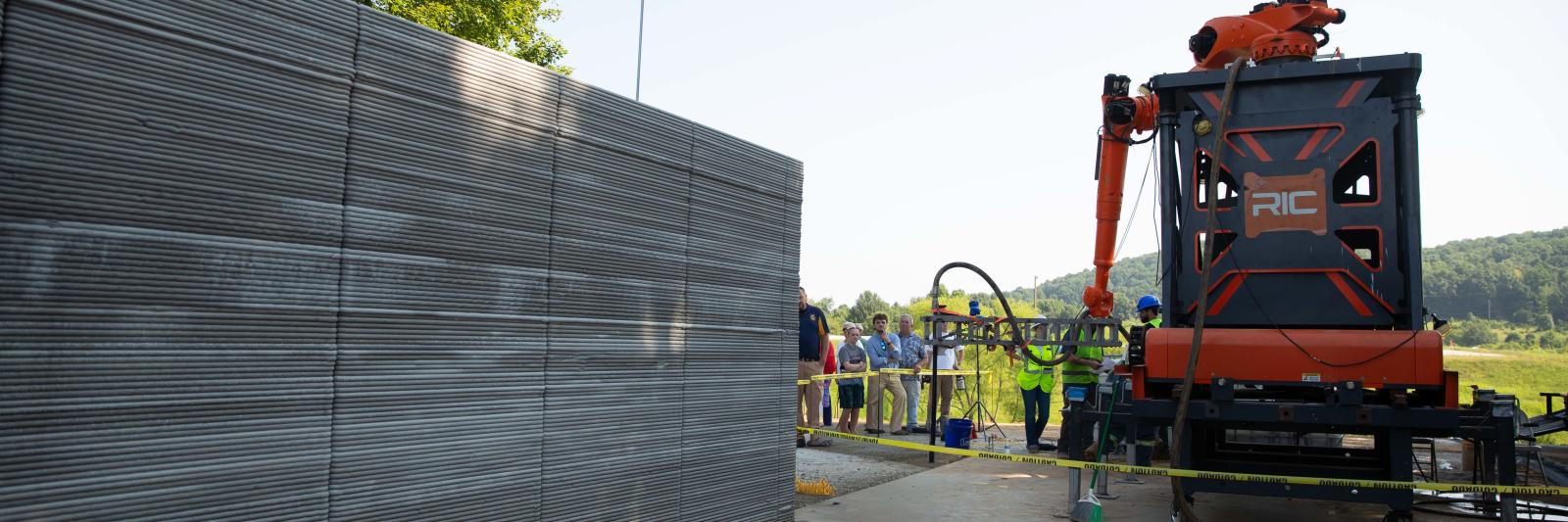
A month after the tornadoes ripped through their community, Wooldridge and his team turned their innovative ideas into reality, casting Kentucky’s first 3D-printed concrete home. Students, faculty, contractors, government officials and the media watched as the house rose — a tangible model of homes engineered to endure whatever Nature Herself throws at them.
Wooldridge and his team began experimenting with 3D-printed concrete (additive manufacturing) homes in 2022, after the Eastern Kentucky floods revealed a stubborn pattern: communities were rebuilt only to be destroyed again.
Seeing the cycle of destruction — as well as the escalating costs to repair or replace homes affected by Kentucky’s wild weather — the USDA reached out to Wooldridge, intrigued by the virtually limitless applications of 3D printing.
“Our Additive Manufacturing Center has been partnering with the Kentucky USDA Rural Development office for many years, and when they came to us with the question of what could be possible with concrete and 3D-printing,” Wooldridge recounts, explaining how that conversation led to the grant that set the project in motion. “We said, ‘Well, a lot could be possible.’”
With additional funding from the Appalachian Regional Commission, that possibility came to life in June with the 3D printing of Kentucky’s first house. The robotic nozzle swept in arcs, drawing concrete walls line by line. With each layer, walls emerged in slow motion, like geological strata taking shape. “Slow” is relative, though. Wooldridge notes that once the machinery is in place, printing a similar home should take just 3-4 days — a fraction of the weeks traditional construction requires.
Constructed without any wood framing, the project was dubbed “Floodbuster 1.” While the name might conjure childhood memories of a Transformer, this is really the Optimus Prime of housing: built to endure tornadoes and floods that threaten lives and livelihoods across the state.