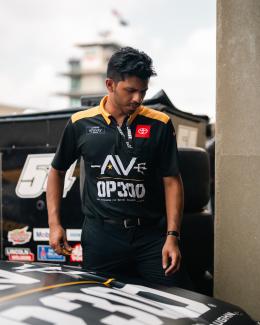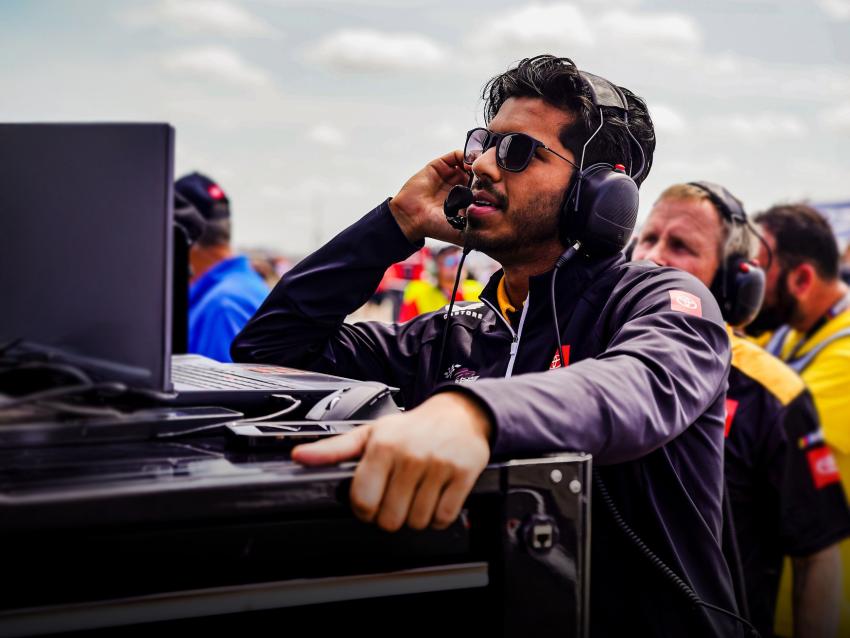
Rahman’s been with the legendary Joe Gibbs Racing team for nearly two years. Just 26, he’s already risen to the primary race engineer for car No. 54 in the NASCAR Xfinity Series, driven by Taylor Gray. It’s a dream job for the Frankfort, Kentucky, native. Still, during Silly Season, he keeps his eyes open for opportunities that could lead to his ultimate ambition: crew chief.
For the uninitiated, NASCAR is part science experiment, part demolition derby, and part traveling roadshow. Forty stock cars outfitted with fire-breathing V8s hurl around an oval track at nearly 200 mph while crews juggle math, mechanics and mayhem on pit road in the pressure cooker of more than 70,000 fans each week. Beneath the spectacle lies an engineering arms race where fractions of a second decide who’s a hero and who’s packing up the hauler by sundown.
The sport is built like a set of stepping stones, each series shaping drivers and engineers for the next level. Many crew members start in ARCA — the Automobile Racing Club of America — a proving ground where rookies, part-timers and hungry up-and-comers learn the ropes on everything from short tracks to superspeedways. That’s where Rahman got his start. From there, many climb into the Xfinity Series, a national stage packed with rising stars and seasoned racers. At the top sits the Cup Series — NASCAR’s crown jewel — where the sport’s best teams chase glory under the brightest lights.
“By the time I’m 30, I want to be leading a car full time — that’s the goal,” he says.
He explains that NASCAR is “definitely a hard industry to break into,” but believes his youth gives him time to learn, fail and grow.
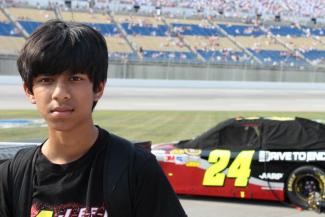
Rahman’s knack for problem-solving, paired with a curiosity for how things work — virtues inherited from his parents — runs through everything he does, always pushing his limits to the redline, from childhood play to his first real taste of racing. He fell for the sport the way many kids do: with matchbox-sized toys that roared across linoleum floor and movies that made cars feel alive.
“My friends and I, we played with Hot Wheels all the time,” remembers Rahman with a victory-lane grin. “Then ‘Cars’ came out. We all kind of point to ‘Cars’ as a pivot in culture for us … it made racing cool. It made NASCAR cool.”
Video games sealed the deal.
“Gran Turismo … Need for Speed … even Mario Kart,” recounts Rahman, rattling off some of the influential titles, several of which he continues to enjoy as an adult.
Drawn in by the competitive nature, ever-changing technology and continuous challenges of motorsports, Rahman was hooked on NASCAR by the time he reached high school.
“It was maybe 2010. 2011? … I just remember really starting to watch it on TV a lot more,” he says. “Once I got introduced to that, I was like, ‘How do I go work in this?’”
Realizing that he’d likely not be in the driver’s seat due to the stiff competition and the fact that others his age were already seasoned behind the wheel, Rahman looked at options that would allow him to be part of the action, part of a winning team. Mechanical engineering looked like the best all-around route to the garage, so he set his sights on UK — helped by a full-ride pathway via the Governor’s School for the Arts scholarship.
“Ultimately, Kentucky was my best bet,” he says. “I ended up getting everything I needed to succeed right at home.”
On campus, between classes and studying, Rahman split his time between hands-on engineering teams and creative projects. He managed the Solar Car Team and led aero and body work for the Formula Kentucky racing (FSAE) program, all while exploring screenwriting and short-film work with friends.
His parents are computer science engineers, but Rahman attributes his creativity to his mother, who is also an accomplished artist.
“It was a good release from the engineering … just enjoyable work,” he says of the university’s Media Depot, where he worked in college and honed his creativity and multimedia skills. “The creative part opens up your thought process a little bit more and you see a bigger picture.
That creative outlet turned out to be more than just a pastime — it became his first bridge into professional racing. Rahman says that former UK mathematics Professor Molly Fisher invited NASCAR driver Ben Rhodes to campus to meet the student racing teams. Rhodes suggested reaching out to Venturini Motorsports for opportunities.
“I had camera experience, and when I was cold-emailing teams, Emily Venturini — the wife of team owner Billy Venturini — noticed it on my résumé,” Rahman explains. “They didn’t have any engineering positions open at the time, but because of my camera work, I was able to intern and help them out with some camera tools in practice, then shadow the rest of the weekend. It turned out to be my first real link to the NASCAR world in college — and obviously, we’ve seen where that ended up taking me!”
Looking back on his time at UK, however, Rahman points to Stanley Pigman — namesake of the Stanley and Karen Pigman College of Engineering — as one of the most formative influences on where he is today.
Rahman recalls how Pigman became a steady source of encouragement and support from Rahman’s freshman year.
“I wouldn't be where I’m at without Stan,” Rahman says plainly. “He gave us the belief and the backing to make things happen. He's so genuine. Every interaction I’ve ever had with him, I've felt like he truly cares about you as a student and your individual goals.”
Pigman’s passion for engineering and cars was infectious, inspiring Rahman and his peers to push the limits of their student-built vehicles. Beyond generous financial support he offered the motorsports teams, Rahman says Pigman offered practical guidance and insight, helping the teams turn ambitious ideas into competitive reality.
Rahman’s time juggling engineering teams and creative projects laid the groundwork for the career he’d build. He says the problem-solving and teamwork demanded by these student organizations taught lessons he still carries into NASCAR today.
“I can’t emphasize enough how much I valued the student org experience at UK,” Rahman says. “The teamwork and analytical thinking we needed on both solar car and FSAE helped shape my expectations through my career in NASCAR so far. There were definitely some tough days, but some of the most fun moments and best learning opportunities I’ve had came with those groups.”